Most first-year engineering students take two physics courses: mechanics, and electricity and magnetism. A key topic in the second is Faraday’s law, which states that a changing magnetic field around a coil induces a voltage. I wanted to apply this principle by designing and building a hand-crank generator.
The design was modeled in SolidWorks and 3D printed before assembly. The generator consists of four stationary 80-turn copper coils and a flywheel holding six neodymium magnets with alternating poles to maximize the change in magnetic flux. The flywheel spins on a ball bearing for smoother rotation and is driven through a gear train, with a larger gear connected to the crank arm and a smaller gear fixed to the magnet assembly. This ratio increases flywheel speed and improves voltage output. All components are mounted on a base with two large side panels. The coils are soldered to an external box containing a full bridge rectifier, which converts the AC output into DC voltage to be measured with a multimeter.

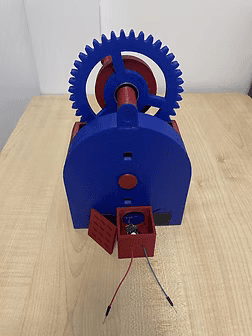

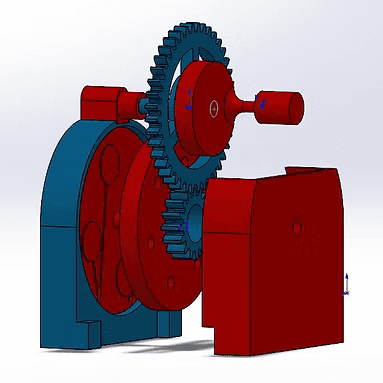

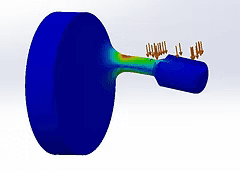
Before 3D printing, I ran FEA stress tests in SolidWorks to analyze stress concentrations at the joint between the crank handle and gear. A direct 90-degree connection showed high localized stress, so I added fillets to distribute the load more evenly and reduce wear. Once assembled, the generator produced a steady 1.42 V DC output, confirming both the design choices and the physics behind it.